


American Revolution
From Protest to Independence
Follow the arguments, personal experiences and decisions that shaped the fight for independence, from the first colonial protests to Washington’s return of military power to Congress.
 Trusted by 100+ Schools
Explore the American Revolution, the Civil War and World War II through reproductions of historical letters and documents. Teach classes with our lesson plan, worksheets and model answers.
For teachers, departments and curriculum leads. A supplement to the history course you already teach.
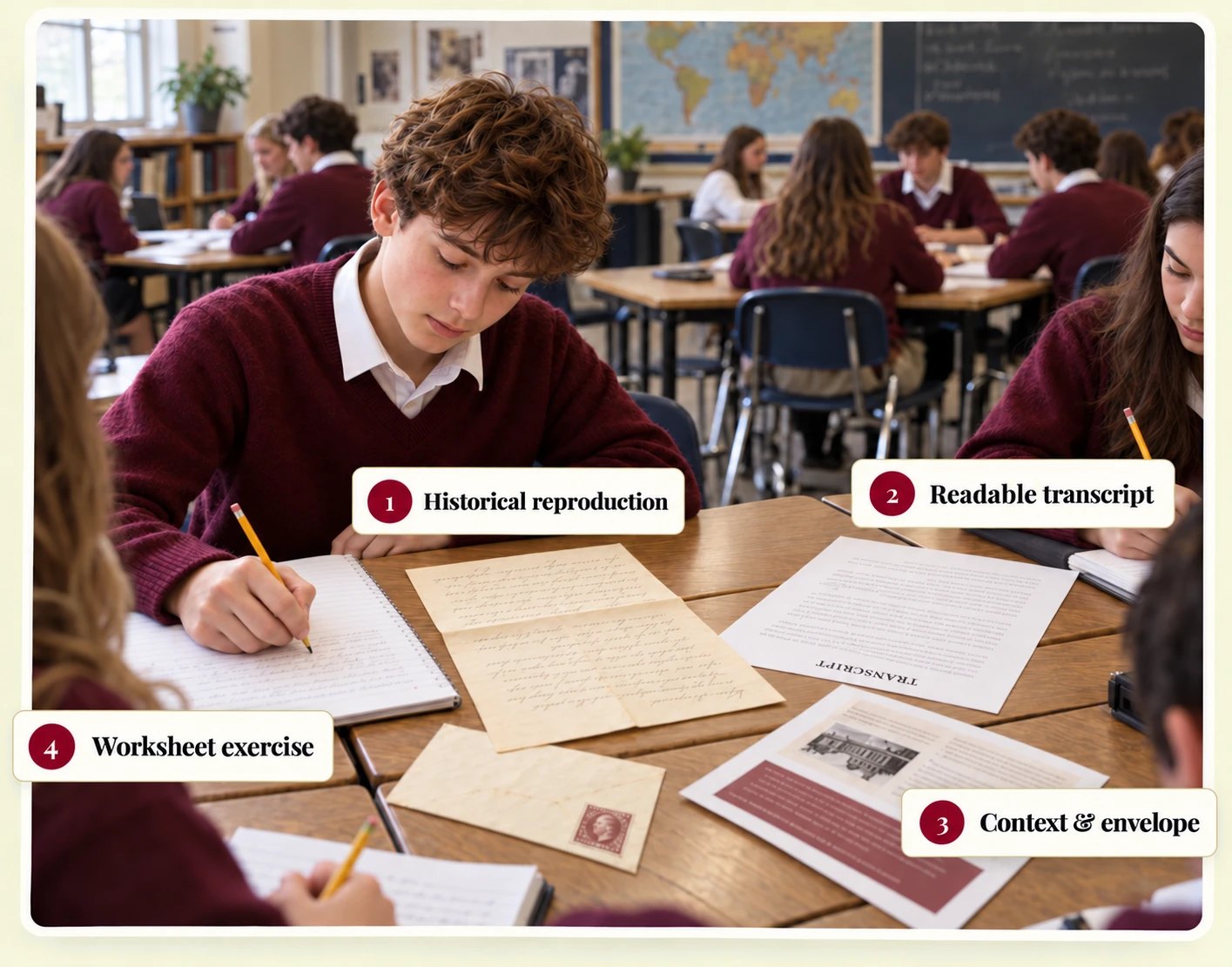


Each collection contains ten different historical documents. Your class receives a student copy of each one, with a readable transcript and historical context. Or choose all three in the Complete History of America.
From Protest to Independence
Follow the arguments, personal experiences and decisions that shaped the fight for independence, from the first colonial protests to Washington’s return of military power to Congress.
From Protest to Independence · 1772–1783 · 10 documents · from $1,099
How did resistance to British rule become a fight for independence?
Compare Franklin’s angry unsent letter with Abigail Adams’s appeal for change. Ask students how audience and purpose shape each writer’s language. An extended task could assess whose ideas of liberty are represented in the collection and whose perspectives require additional sources.
War, Freedom and Citizenship
Explore the Civil War through the words of presidents, soldiers, abolitionists and people seeking freedom, and the links between victory, emancipation and the human cost of war.
War, Freedom and Citizenship · 1861–1865 · 10 documents · from $1,099
How did the struggle to preserve the Union become a struggle over freedom and citizenship?
Compare Grant’s arguments for Black enlistment with Gooding’s request for equal pay. Use Davis’s letter to explore the limits of emancipation. Students can develop an evidence-based essay about the relationship between service, freedom and citizenship.
Decisions, Service and Responsibility
Examine wartime choices through letters about scientific discovery, alliances, service, discrimination and responsibility, and compare public encouragement with private doubt.
Decisions, Service and Responsibility · 1939–1945 · 10 documents · from $1,099
How did people justify decisions and demand action during global war?
Compare the two Eisenhower messages and ask how audience changes tone and purpose. Examine the tensions between wartime service and discrimination using Brown and Davis. An essay could assess how wartime leaders justified difficult decisions, using several sources and additional historical context.
All three collections, from independence to world war
Every document from the American Revolution, Slavery and the Civil War, and World War II collections. Your class follows how Americans argued about liberty, union and responsibility across nearly two centuries, all in one delivery.
By mail A copy for every student
Digital Supplied digitally for the teacher
Real example: American Revolution, Document 1. Samuel Adams to James Warren, 4 November 1772. Image courtesy of the Massachusetts Historical Society.
A replica of the original letter or document, retaining its historical appearance: the handwriting, letterhead, corrections and layout students would see in an archive.
Some selections are telegrams, public messages or unsent drafts. Each one is identified in the collection details, and a document may run to more than one page.
Every reproduction arrives in a Historic Mail envelope.
Real example: American Revolution, Document 1. Samuel Adams to James Warren, 4 November 1772.
The original wording, set in clear type so students can read every line without deciphering old handwriting.
The transcript keeps the writer’s own words. It is not a simplified rewrite: vocabulary support and modern-language tasks are kept separate, in the student worksheet.
Real example: American Revolution, Document 1. Samuel Adams to James Warren, 4 November 1772.
A short briefing on who wrote the document, who received it, what was happening at the time and why it matters, so students can place the document in its moment.
Context sheets distinguish historical events from the writer’s own claims and from later interpretation.
Real example: American Revolution, Document 1. Samuel Adams to James Warren, 4 November 1772.
A one-page worksheet for each document, marked out of 15, that takes students from reading the source to writing about it.
A printed copy arrives for every student with each document, so there is nothing to photocopy.
Real example: American Revolution, Document 1. Samuel Adams to James Warren, 4 November 1772.
An optional 50-minute lesson built around each document. Follow it as written or take individual activities.
Real example: American Revolution, Document 1. Samuel Adams to James Warren, 4 November 1772.
Everything you need to mark the worksheet out of 15.
Supplied to the teacher only, so the answers stay out of students’ hands.
Reproductions, transcripts, context sheets and student worksheets arrive by mail, a printed set for every student. Lesson plans and answer keys are supplied digitally to the teacher.
Select one of the three collections to match the period you are teaching.
Order a set for 20 or 30 students and tell us the name the mail should be addressed to, such as your class or department.
All ten document sets arrive at your school together in one delivery: about ten weeks of material, ready to use whenever you choose.
Use the suggested activities or adapt the documents to your own lesson plans.
A class of 20 receives 20 student copies of each of the 10 documents: 200 document copies across the collection, for $1,099 at $54.95 per student.
This counts document copies, not mailings or printed pages. Some documents run to more than one page. Shipping is free.
All ten document sets arrive together, so you can use them at your own pace.
Short factual questions about author, recipient, date and events, using the transcript and context sheet.
Identify a claim, select supporting words and explain what they suggest about the writer’s perspective.
Compare authors, purposes or documents and consider what each source leaves out.
Rewrite a short passage in modern language, preserving its meaning, then explain what changed. Student writing stays clearly separate from the historical text.
Write a longer response using two or more documents and relevant historical context.
Use a letter as a lesson starter, a group discussion, a source-analysis exercise or the starting point for extended writing. The activities are there to support your teaching; you choose how far to take them.
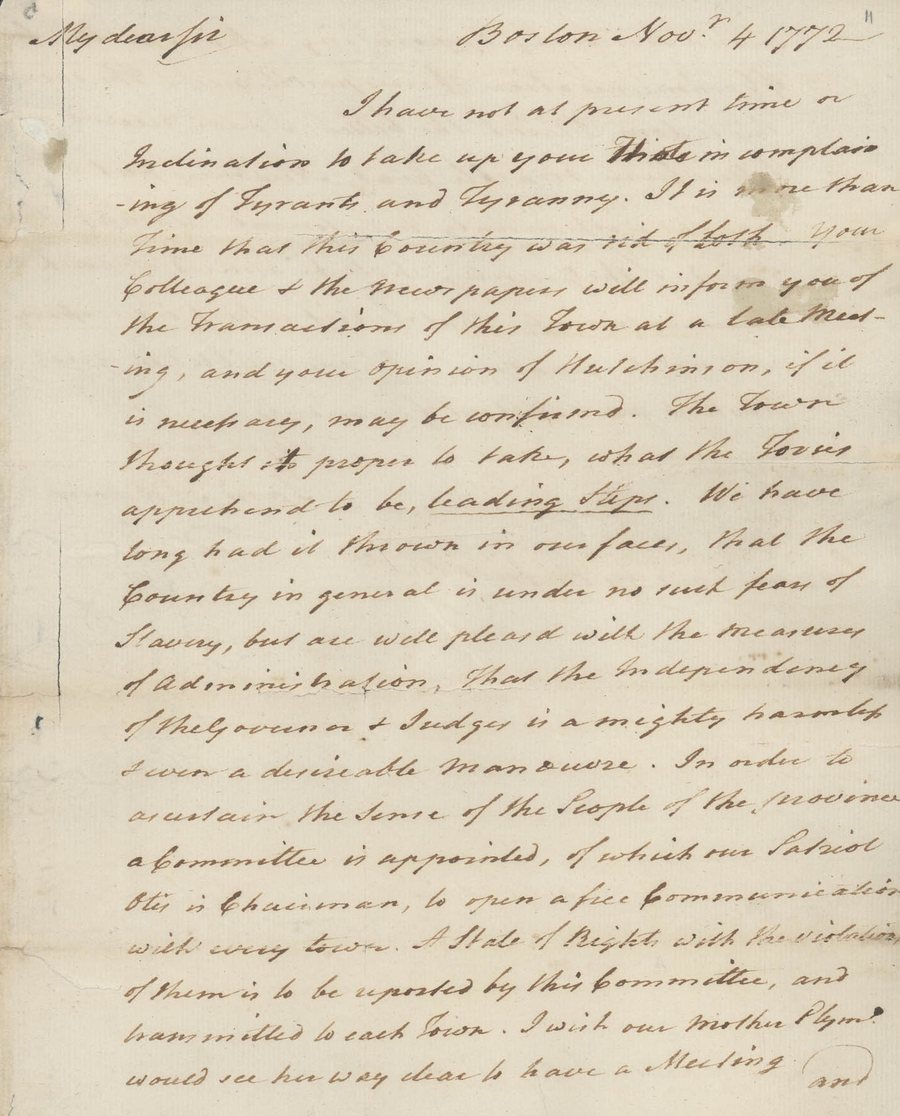
Page 1 of 2. Image from the collections of the Massachusetts Historical Society. Not to be reproduced without permission.
In November 1772, Samuel Adams wrote from Boston to his friend and political ally James Warren in Plymouth. Boston had just set up a Committee of Correspondence to “open a free Communication with every town”, and Adams urged Plymouth to “second Boston” with a committee of its own.
The letter shows students how resistance was being organised years before the fighting began, and asks them to weigh what a private letter between allies can and cannot tell a historian.
They are reproductions of historical letters and documents, accompanied by readable transcripts and context. Some selections are telegrams, public messages or unsent drafts, identified in the collection details.
Yes. Choose a class set for 20 or 30 students, and each student receives their own copy of every document in the collection. If your class falls between the two, choose the 30-student set. Teaching more than one class? Add a set for each class.
All ten document sets for your collection arrive at your school together in one delivery, giving you about ten weeks of material to use whenever it suits your course. Shipping is free.
No. Everything arrives at once, so you can use the letters when they fit your course: one a week, several in a single unit, or spread across the year. The activities can support a short discussion, source analysis or a longer writing task.
Every student receives a printed worksheet with each document, alongside its transcript and context sheet. The teacher also receives a suggested 50-minute lesson plan and an answer key with an essay scoring guide for each document, supplied digitally. You choose which questions and activities to use.
It is a supplementary resource for your existing history teaching. Suggested grade ranges help you choose a collection; teachers should review its documents and topics for their class.
Each collection comes as a class set: $1,099 for 20 students or $1,549 for 30 students, down from $1,600 and $2,300. That covers a student copy of all ten documents, each with its readable transcript, historical context and printed worksheet, plus the teacher’s lesson plans and answer keys.
The Complete History of America includes all three collections, 30 documents, for $2,499 (20 students) or $3,699 (30 students), down from $4,600 and $6,800. Shipping is free, and any applicable tax is added at checkout.


